How to Test and Ensure Cloud Application Resilience Against Amazon SQS Outages Using AWS Fault Injection Service

When enterprise applications can no longer send, receive, or process messages through an Amazon Simple Queue Service (Amazon SQS) queue, downstream processing pipelines inevitably stall. Modern distributed systems rely heavily on message queuing to decouple components, manage peak workloads, and maintain high availability. However, when these asynchronous communication channels break down—whether due to a misconfigured Identity and Access Management (IAM) policy, a network partition, a faulty deployment, or a transient regional service event—the application layer frequently reacts in unpredictable ways. Without rigorous proactive testing, engineering teams are often left relying on unverified assumptions about how their software will behave under duress.
To bridge this operational visibility gap, cloud architects and reliability engineers are increasingly turning to chaos engineering principles. By leveraging the AWS Fault Injection Service (AWS FIS) alongside AWS Systems Manager Automation, teams can simulate controlled access disruptions to SQS queues. Rather than testing whether AWS infrastructure functions properly, these resilience experiments evaluate application-level recovery mechanisms, fail-fast protocols, circuit-breaker states, and monitoring observability during real-world failure scenarios.
Understanding the Control Plane Versus Data Plane
In cloud-native architecture, distinguishing between control plane and data plane operations is paramount. The control plane handles resource provisioning, management, and configuration tasks, such as creating queues or updating access policies. Conversely, the data plane manages the high-throughput, operational workflows—namely, sending, receiving, deleting, and modifying the visibility of messages within a queue.
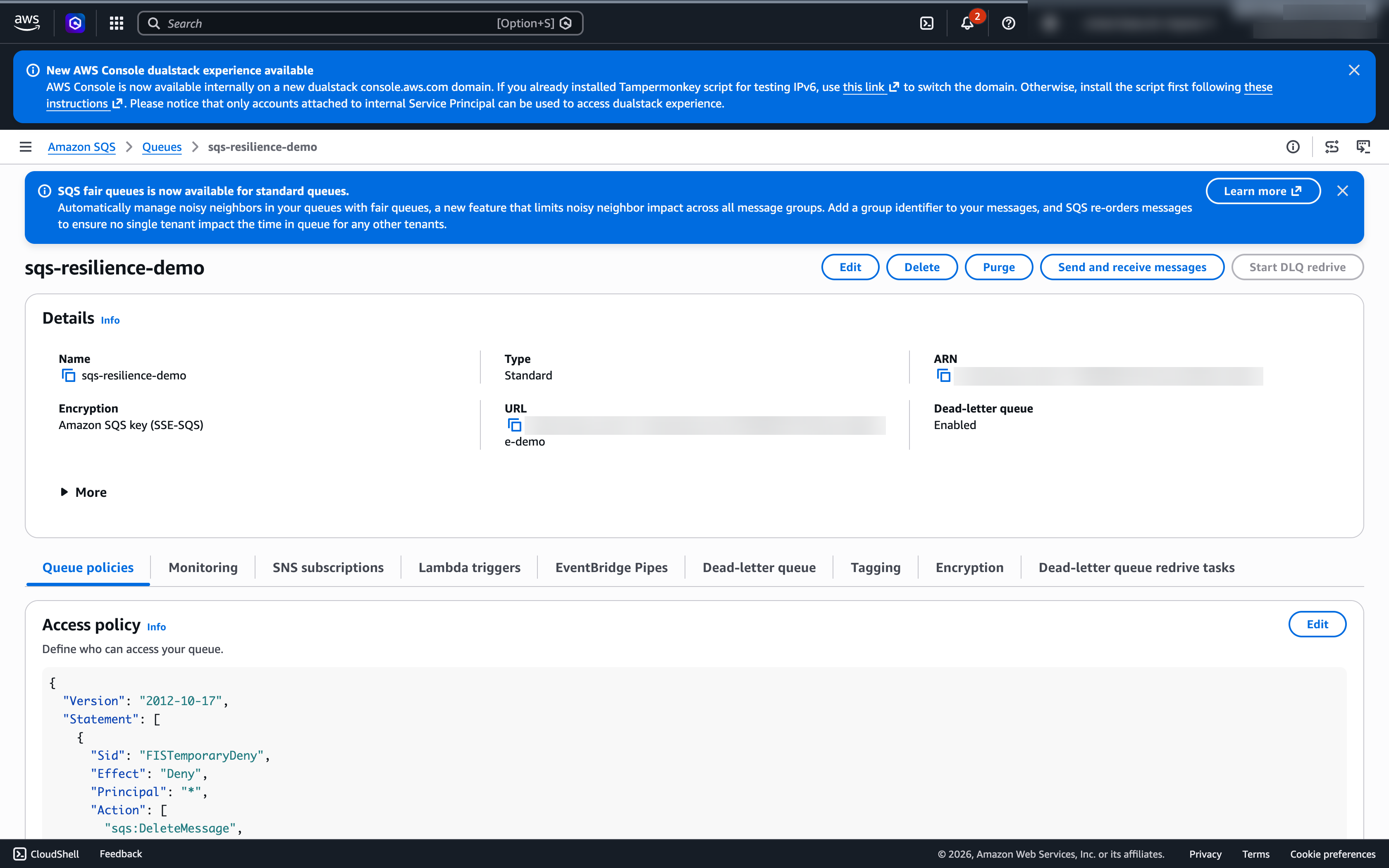
When designing a fault injection experiment to simulate an SQS outage, engineers must carefully scope any restrictive IAM resource policies to target data-plane actions exclusively. Applying an explicit Deny statement to broad permissions like sqs:* can inadvertently override all Allow permissions, locking out administrators and automation roles alike. A misconfigured policy that restricts management actions such as sqs:SetQueueAttributes or sqs:RemovePermission can permanently orphan a queue, preventing automated rollback mechanisms from cleaning up the test environment. Consequently, safety best practices dictate that experiment policies must be strictly scoped to block only operational message-handling APIs while preserving management plane access.
Progressive Experiment Phases and Structured Escalation
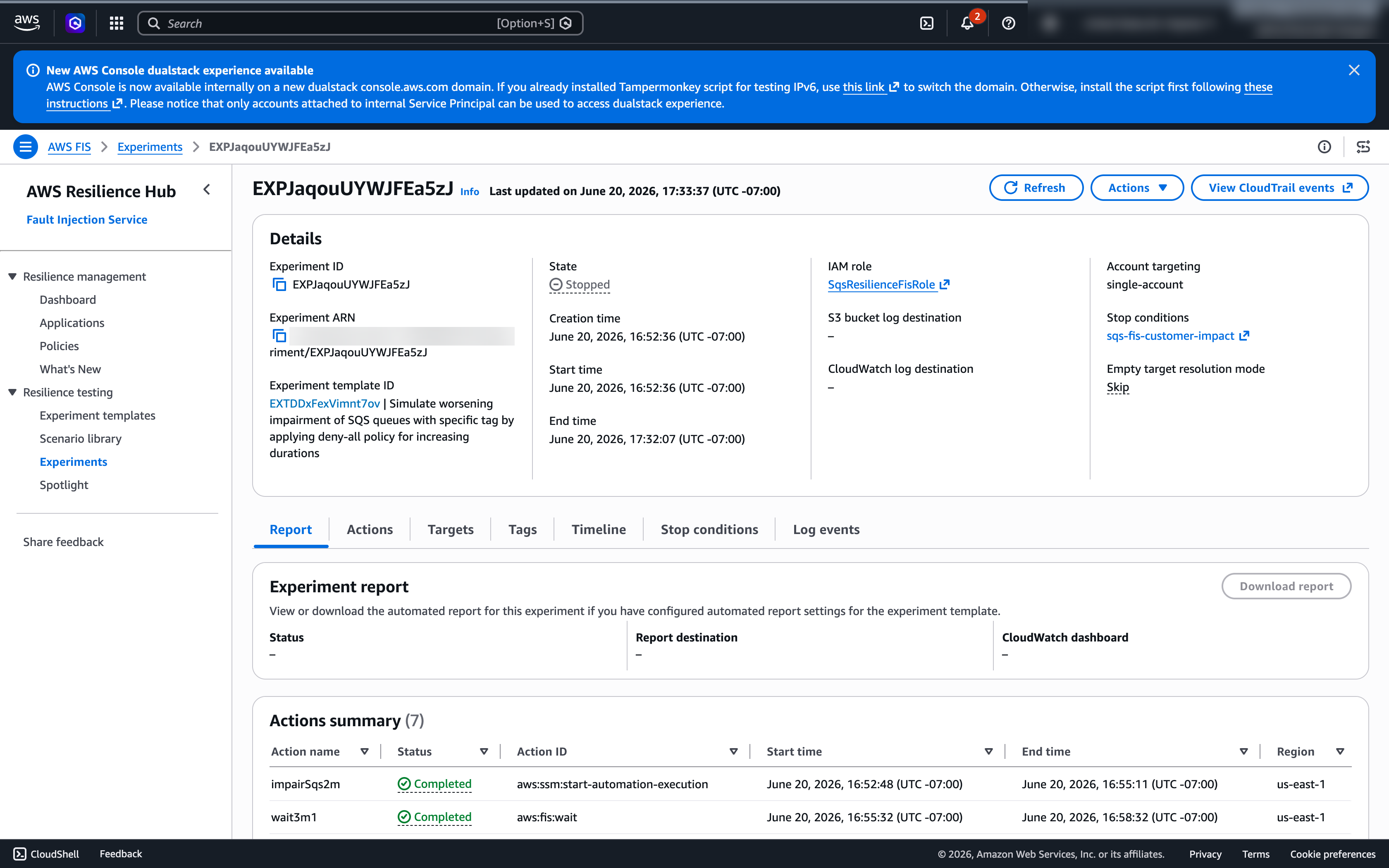
A comprehensive resilience experiment is rarely executed in a single, prolonged block. Instead, best practices recommend a progressive, multi-phase escalation strategy that exposes different classes of system failures over time. Short disruptions typically reveal whether basic fail-fast mechanisms and circuit breakers activate correctly, whereas extended outages uncover systemic bottlenecks, including thread-pool saturation, memory leaks, and cascading downstream errors.
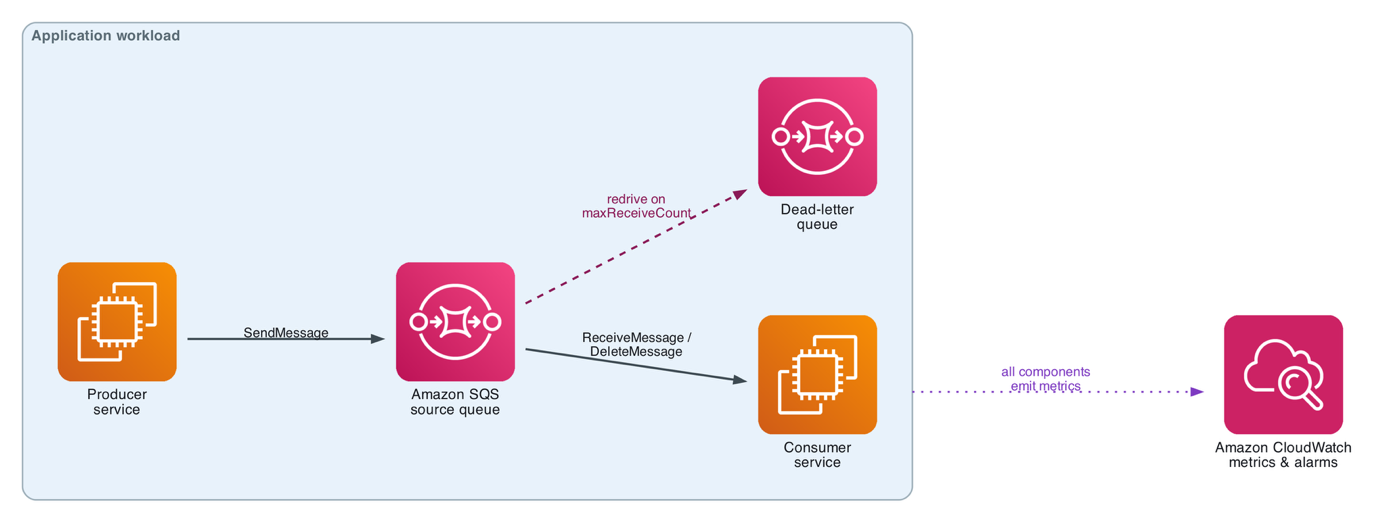
A standard progressive testing framework involves four distinct impairment intervals chained together with intermediate recovery periods:
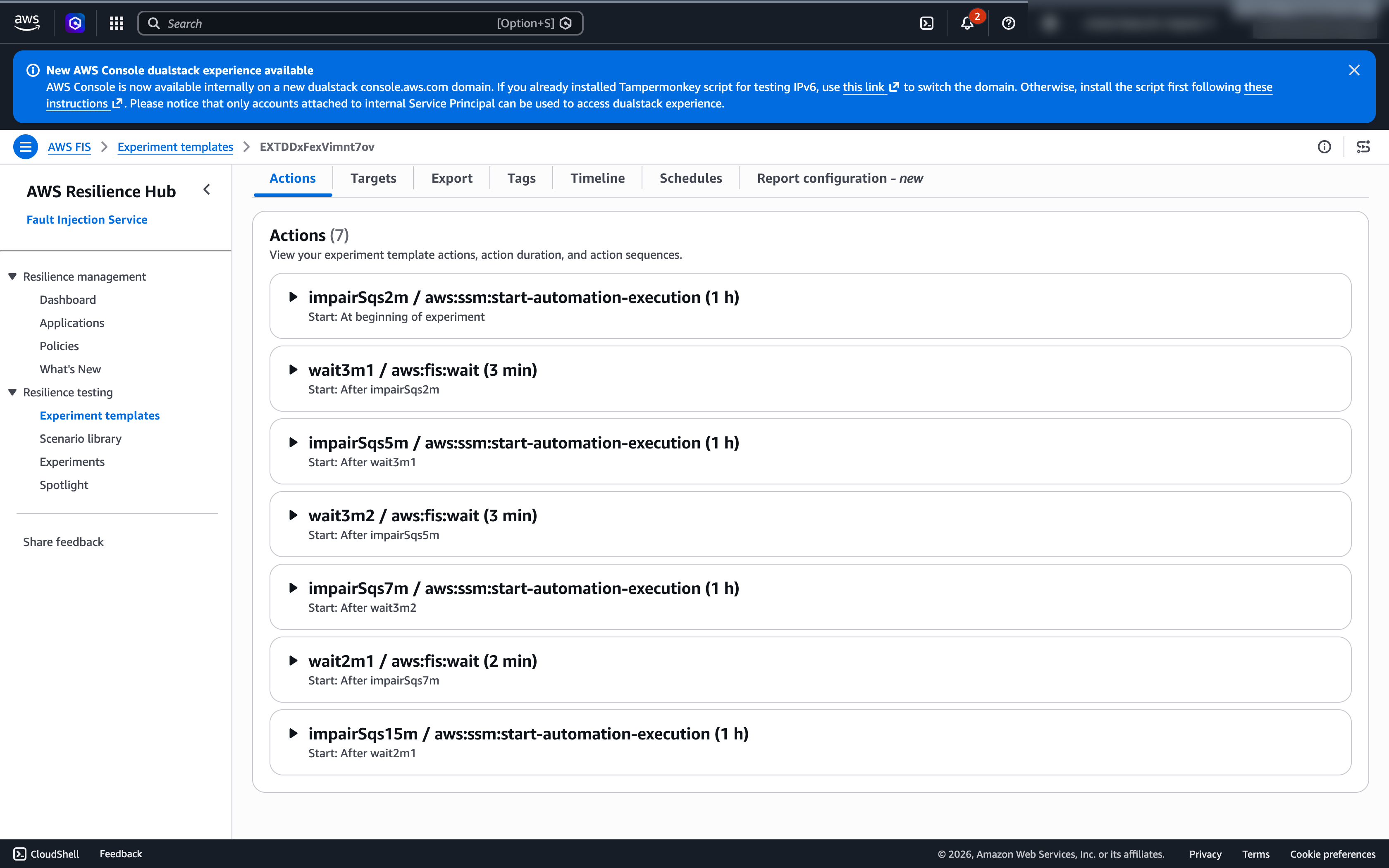
- Initial Impairment (2 Minutes): Tests immediate error recognition, fail-fast logic, and initial circuit-breaker activation.
- First Recovery Window (3 Minutes): Evaluates how effectively buffered messages replay and whether performance metrics return to baseline.
- Secondary Impairment (5 Minutes): Measures backlog accumulation rates as the queue fills completely without being drained.
- Extended Impairment (7 to 15 Minutes): Surfaces deep architectural limits, such as memory pressure, connection-pool exhaustion, and thread-pool degradation under sustained pressure.
By carefully monitoring producer and consumer components independently during these phases, teams gain granular insights into their software’s fault-tolerance boundaries.
Producer-Side Versus Consumer-Side Dynamics
During an SQS access disruption, producers and consumers exhibit markedly different failure signatures that require separate observation strategies.
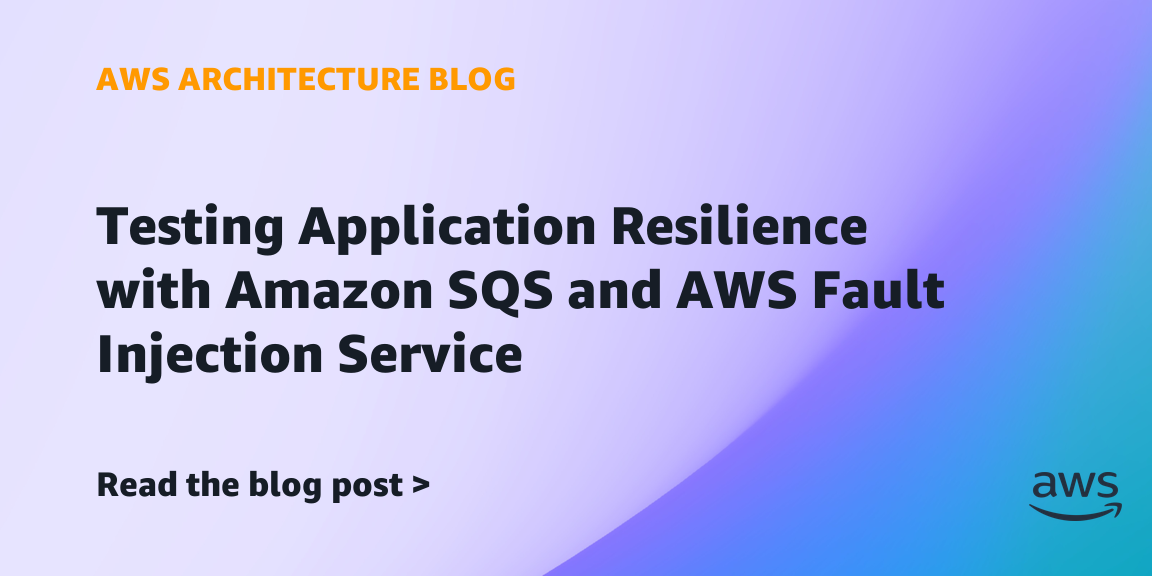
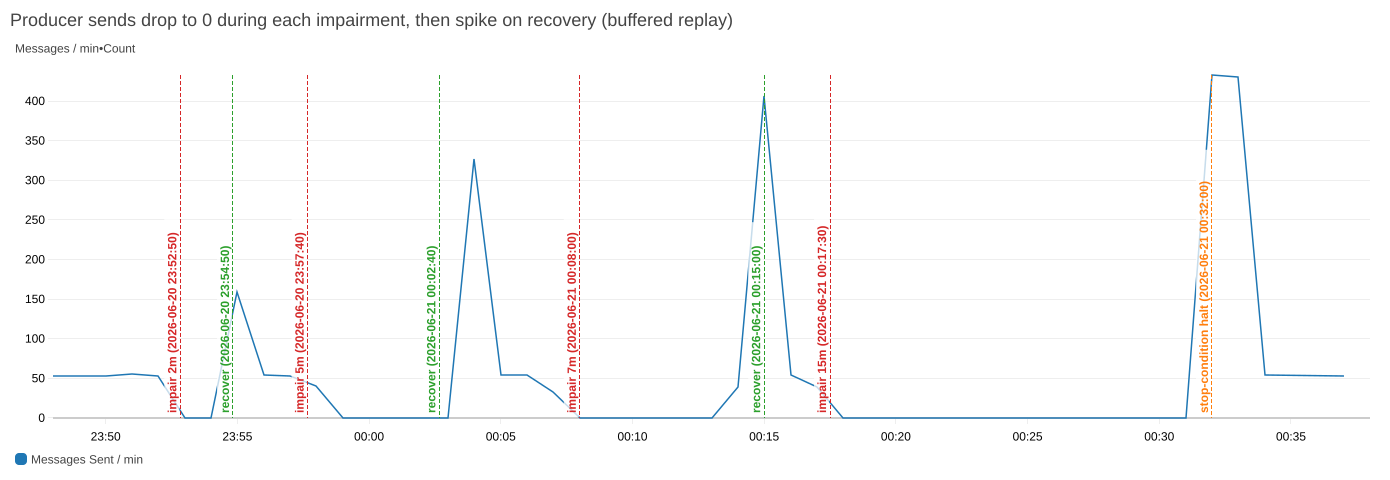
On the producer side—the component responsible for executing SendMessage operations—an access-denied error is treated as a non-retryable 403 fault. A resilient producer must recognize this error instantly, avoid entering tight retry loops that exhaust CPU resources, and trip a circuit breaker after a threshold of consecutive failures. Furthermore, well-architected producers should preserve application stability by persisting payloads to durable local or secondary fallback storage rather than dropping messages silently into the void.
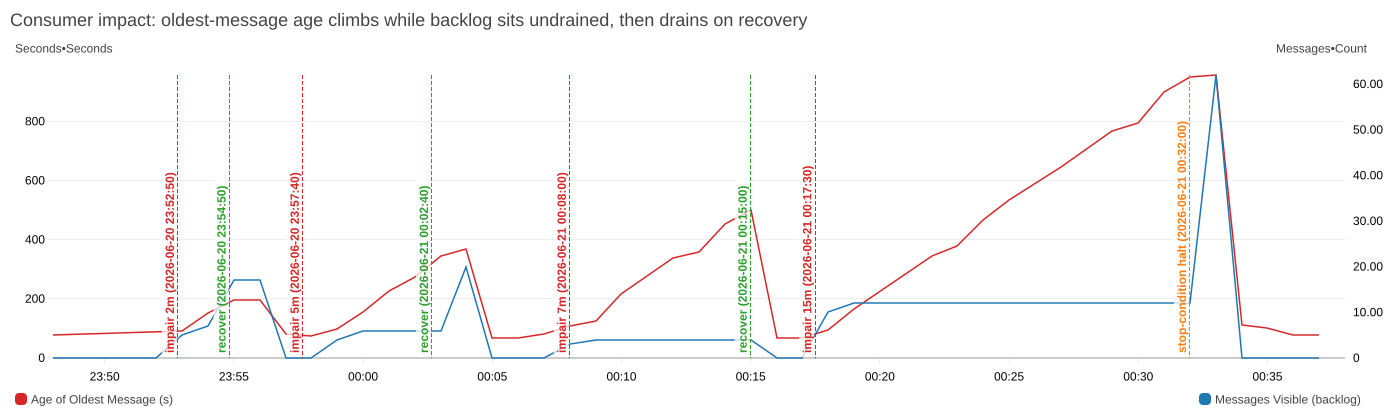
On the consumer side—components executing ReceiveMessage and DeleteMessage APIs—outages manifest as unfulfilled polling loops and rising backlogs. During a consumer-side disruption, visible message counts (ApproximateNumberOfMessagesVisible) plateau or climb rapidly, while the age of the oldest message (ApproximateAgeOfOldestMessage) increases. Crucially, engineering teams must recognize that dead-letter queues (DLQs) will not accumulate messages during the active impairment phase. Because message redrive relies on the maxReceiveCount threshold being met through actual message delivery and subsequent processing failures, DLQ activity typically occurs only during the post-recovery phase when consumers attempt to process an overwhelming backlog.
Hypothesis-Driven Testing and Guardrails
Before launching any fault injection experiment, teams must formally establish a test hypothesis. This document outlines the anticipated system behavior, acceptable performance degradation windows, and specific recovery metrics. If an experiment violates established safety thresholds, automated stop conditions tied to Amazon CloudWatch alarms must immediately halt the run and trigger a rollback of the IAM deny policy.
Selecting appropriate stop conditions requires careful calibration. Alarming on queue metrics such as message age or sent counts is generally counterproductive, as those indicators are explicitly expected to deviate during an outage. Instead, stop conditions should be linked to broader customer-impact signals, such as sustained application error rates or degraded HTTP response times. If customer-facing error rates exceed tolerable limits for longer than the defined hypothesis window, AWS FIS automatically aborts the experiment, safeguarding production traffic from prolonged disruption.
Implementing Retry Logic, Circuit Breakers, and DLQs
The insights gathered from SQS fault injection experiments directly inform architectural hardening across four core resilience patterns:
- Intelligent Retry Logic: Applications must be configured to distinguish between transient, retryable faults—such as network timeouts or service throttling—and permanent, non-retryable errors like access denial. Utilizing exponential backoff with randomized jitter prevents thundering herd problems when a dependent service recovers.
- Circuit Breakers: By tripping after a designated sequence of failures, circuit breakers halt outgoing requests temporarily, preserving local computing resources and giving the downstream service breathing room to recover.
- Dead-Letter Queues and Idempotency: Every production queue should feature an attached DLQ with an appropriately configured retention period. Because redriving messages inevitably results in duplicate delivery attempts, downstream consumer services must be engineered to be strictly idempotent.
- Comprehensive Monitoring Dashboards: Operational visibility requires unifying queue-level Amazon CloudWatch metrics with application-side telemetry, including circuit breaker states, fallback storage write rates, and thread-pool utilization.
Broader Industry Implications and Future Testing
As enterprise cloud estates grow increasingly complex, static architectural reviews are no longer sufficient to guarantee uptime during infrastructure anomalies. Chaos engineering and fault injection have transitioned from experimental novelties to standard operational disciplines required for mission-critical software development.
Organizations that regularly test their applications against simulated SQS failures significantly reduce their mean time to recovery (MTTR) during actual outages. By shifting left—discovering system vulnerabilities in controlled, non-production environments rather than during high-stakes production incidents—engineering teams build robust, self-healing architectures capable of withstanding the inevitable unpredictability of distributed cloud environments.
Related posts: